growwithaishwarya.com

How Much Earn Digital Marketing Freelancer In India?

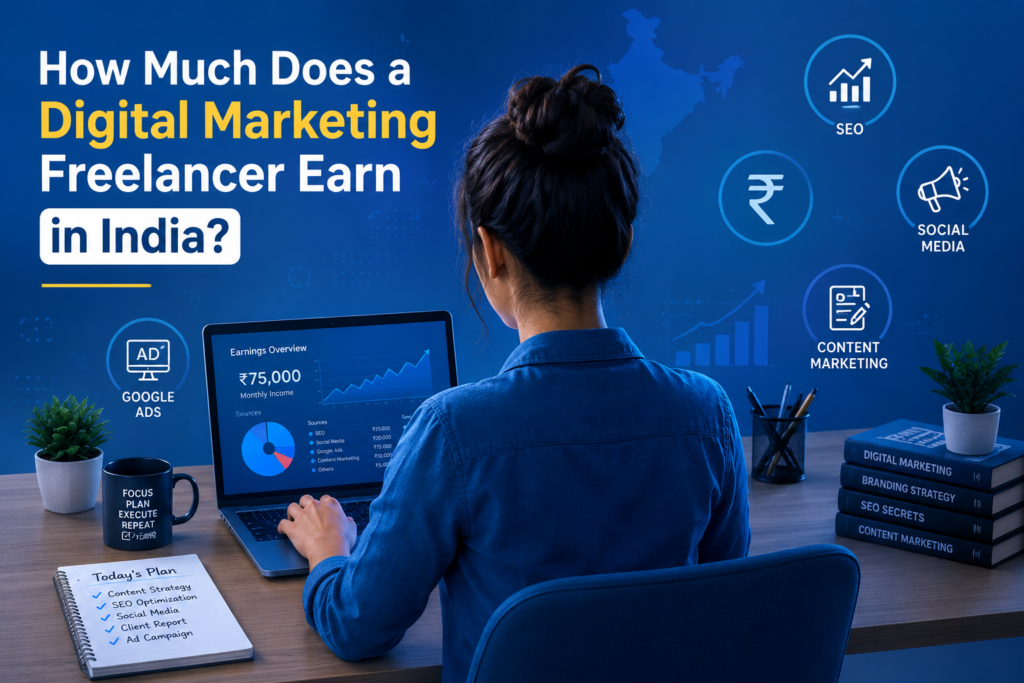
How Much Does a Digital Marketing Freelancer Earn in India?

If you’re thinking about becoming a freelance digital marketer, or you’re already one and wondering if you’re charging enough, you’ve probably asked yourself: “How much money can I actually make doing this?” The honest answer is — it depends a lot on your skills, your clients, and how long you’ve been doing this. But let’s break it down in simple terms, so you know exactly where you stand and what to aim for. The Short Answer A digital marketing freelancer in India can earn anywhere between ₹20,000 to ₹2,00,000 or more per month</cite>, depending on your skills, experience, and the clients you work with. Some beginners make less than that when starting out, and top freelancers with the right skills and international clients can earn much more. Beginners: What to Expect in Your First Year If you’re just starting out, don’t expect big numbers right away. <cite index=”12-1″>Most beginner freelancers with 0-1 year of experience earn around ₹15,000 to ₹30,000 per month in India</cite>, usually by working with 2-3 small clients. Why so low in the beginning? Because you’re still building your portfolio — proof that you can actually get results for clients. Once you have a few success stories to show, your rates go up fast. Simple tip: In your first year, focus more on learning and collecting testimonials than on making big money. The income comes later. Mid-Level Freelancers: 2-5 Years In Once you’ve got a couple of years of real client work behind you, things start looking better. <cite index=”13-1″>Mid-level professionals with 2-5 years of experience typically make ₹30,000 to ₹1,00,000 per month.</cite> At this stage, you’re usually doing one of these things differently than beginners: Experienced Freelancers: 5+ Years This is where the real money starts. <cite index=”13-1″>Experts with 5 or more years of experience can charge anywhere from ₹70,000 to over ₹2.5 lakh per month</cite>, depending on how specialized they are. At this level, freelancers usually aren’t just “doing tasks” for clients anymore — they’re seen as strategic partners who bring in real results like more leads, more sales, or more traffic. What About Working With Foreign Clients? This is the big secret that most successful Indian freelancers know: foreign clients pay much more than Indian clients for the exact same work. So if you’re comfortable communicating in English and understand how international clients like to work, this can be a huge income boost. Hourly Rates: A Quick Look Some freelancers prefer charging by the hour instead of monthly. Here’s roughly what that looks like: However, most successful freelancers actually prefer monthly retainers over hourly billing, because it gives more stable, predictable income instead of unpredictable hour-by-hour payments. What Actually Decides How Much You Earn? It’s not really about how many years you’ve been freelancing. It comes down to a few simple things: Which Skills Pay the Most? If you want to earn on the higher end, these are the skills worth focusing on right now: Freelancers with these skills tend to earn noticeably more than those who only offer basic services like posting on social media. The Bottom Line There’s no fixed salary for a freelance digital marketer in India — your income really is in your own hands. A beginner might start around ₹15,000-20,000 a month, while an experienced specialist working with the right clients can cross ₹1-2 lakh a month or more, especially with international clients. The fastest way to grow your income isn’t just “working harder.” It’s: Freelancing in digital marketing is a real, growing career in India — but like any skill-based career, what you earn depends on how good you get and how well you position yourself.
Uncategorized

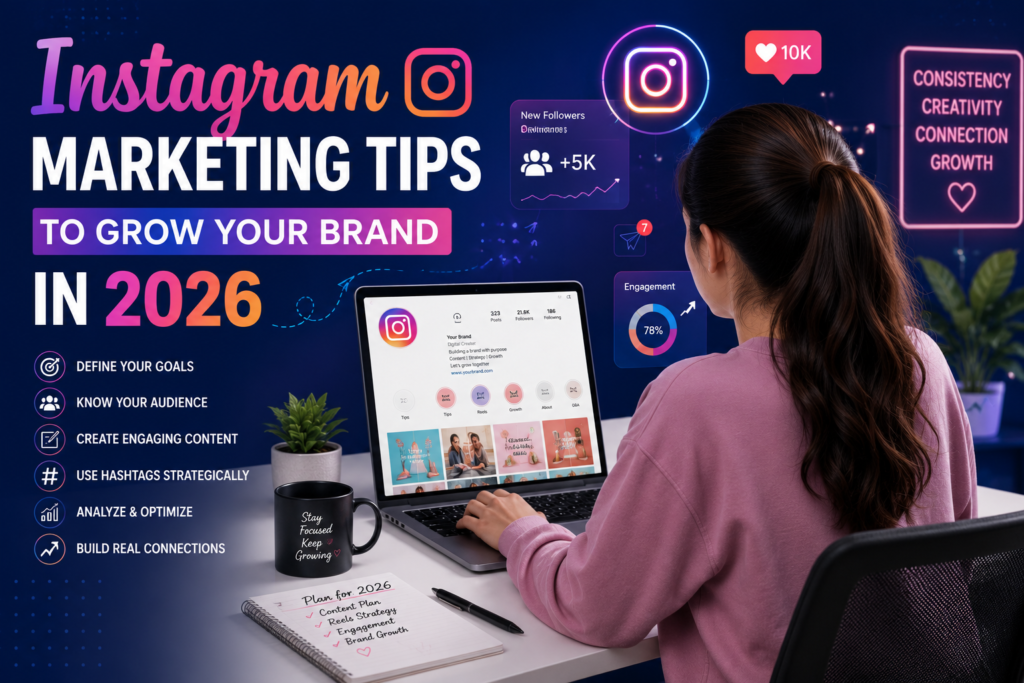
Instagram Marketing Tips to Grow Your Brand in 2026

If you’re still posting the way you did in 2023 — polished photos, a caption stuffed with hashtags, crossed fingers — you’ve probably noticed your reach isn’t what it used to be. Instagram in 2026 is a different animal. The algorithm cares about different things, the formats that win are different, and honestly, the whole vibe of what “good content” looks like has shifted. The good news? None of this requires a bigger budget or a professional camera crew. It just requires knowing where the platform is actually headed. Here’s what’s working right now. 1. Stop chasing likes — DM shares are the new currency This is probably the biggest shift nobody warned you about. Instagram now weighs a “send” — someone sharing your post to a friend via DM — far more heavily than a like when deciding how widely to distribute your content. A like takes zero effort and means very little. A DM share means someone thought about a specific person and sent it to them. That’s a real trust signal, and the algorithm rewards it accordingly. What to actually do: Make content people want to tag a friend under, or send directly. Relatable humor, “this is so you” moments, and genuinely useful tips people want to pass along all work well. If you’re not sure whether a post is “send-worthy,” ask yourself: would I personally DM this to someone? 2. Carousels are quietly having a moment Static single images have been fading for a while, but carousels are doing the opposite — engagement on them has climbed noticeably over the past year. They reward the kind of content that makes people stop and swipe: how-tos, frameworks, before/afters, step-by-step breakdowns. What to actually do: Treat your first slide like a headline. It has to earn the swipe in under a second. Then build in a reason to keep going — a numbered list, a “wait for it” moment, an open loop that only resolves on the last slide. Repurposing your best blog posts or product tips into carousel form is an easy win if you’re short on time. 3. Let go of the highlight reel Audiences are tired of content that looks like it came out of a studio. Behind-the-scenes clips, unscripted talking-head videos, and slightly imperfect moments are consistently outperforming the polished stuff. It’s not that quality doesn’t matter — it’s that authenticity has become part of the quality bar. What to actually do: Mix in raw footage alongside your more produced content. A phone clip of your team packing orders, a quick clarification when something didn’t go to plan, a founder just talking straight to camera — these humanize your brand in a way a perfect product shot never will. 4. Captions aren’t optional anymore The vast majority of people scroll with the sound off. If your Reels depend on someone hearing the audio to understand the point, you’re losing most of your potential audience before they even get the message. On-screen text has also become a creative tool in its own right — well-timed captions that move with your speech make a video feel more polished, not less. What to actually do: Caption every Reel. Most editing apps auto-generate captions now, so there’s no excuse — just take the extra minute to clean them up so they’re accurate and well-timed. 5. Post with intention, not frequency The old advice to post multiple times a day to “stay visible” doesn’t hold up anymore. Instagram’s algorithm now favors resonance — how deeply people engage with a post — over sheer volume. Flooding your grid with mediocre content can actually work against you. What to actually do: Before you post, ask whether the piece genuinely educates, entertains, or means something to your audience. If the honest answer is no, hold onto it and refine it instead of rushing it out. 6. Go wide with micro-influencers instead of betting on one big name Single celebrity endorsements are losing their punch, while coordinated campaigns with several smaller creators are proving both cheaper and more effective. Nano and micro-influencers tend to have tighter, more trusting relationships with their followers, which translates into engagement that a mega-influencer’s audience often can’t match. What to actually do: Instead of saving your entire budget for one big name, spread it across a handful of niche creators who already talk to your target audience. You’ll get more authentic content and more entry points into different communities. 7. Make your profile a real storefront Instagram has become a genuine shopping destination, not just a place to discover products. Between shoppable tags, AR try-ons, and in-app checkout, the distance between “I saw this” and “I bought this” has basically disappeared. What to actually do: Audit your profile like a customer would. Are your best-selling products tagged? Is your bio doing its job? Is your Story highlights section organized in a way that actually helps someone decide to buy? Treat every post as a potential entry point into your funnel, not just a broadcast. 8. Write for search, not just for scroll Instagram is increasingly functioning as a search engine in its own right, and even getting indexed by Google in some cases. Vague, purely aesthetic captions are a missed opportunity. People are typing real questions into that search bar. What to actually do: Think about the words your ideal customer would actually search for, and work them naturally into your captions, alt text, and bio — the same way you’d think about SEO for a website. The bottom line Instagram in 2026 rewards brands that feel like real accounts run by real people, not marketing departments. Lean into carousels, caption everything, share more of the unfinished and behind-the-scenes moments, and build relationships with smaller creators instead of chasing one big splash. None of this is about doing more — it’s about being more deliberate with what you post and why. Start with just one or two of these changes this month. Watch what happens to your

Digital Marketing Freelance vs Agency

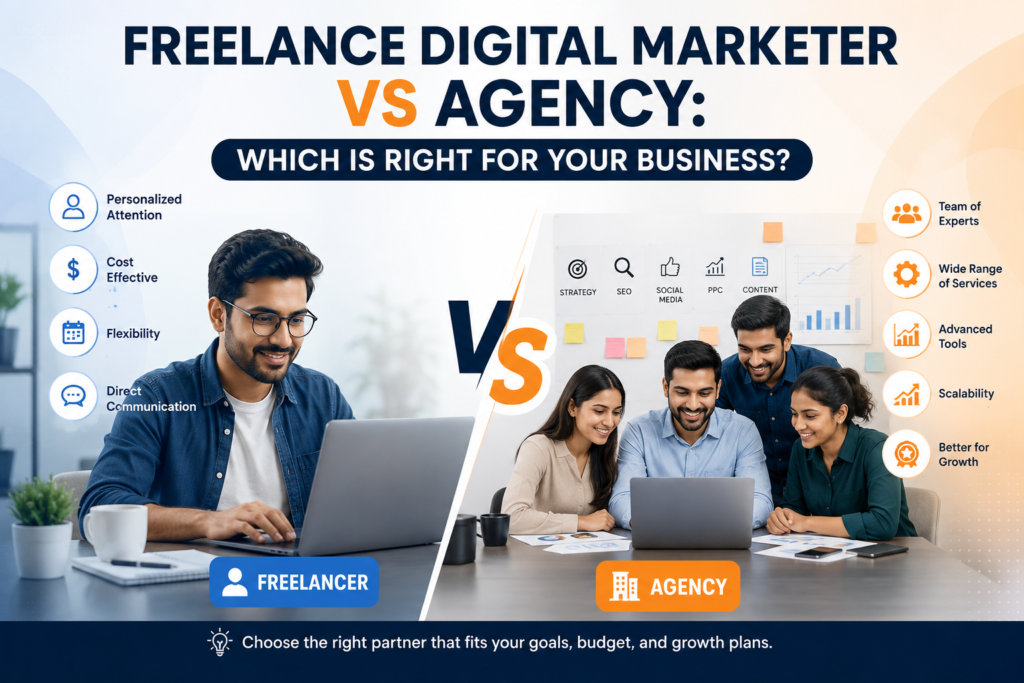
Freelance Digital Marketer vs Agency: Which is Right for Your Business?

Meta Description: Should you hire a freelance digital marketer or an agency? Compare the pros, cons, and costs to decide what’s best for your business. Introduction When it comes to outsourcing your digital marketing, businesses often face a common dilemma: should you hire a freelance digital marketer or partner with a full-service agency? Both options can help you grow your online presence, but they come with very different experiences, costs, and levels of support. Making the right choice depends on your business size, budget, goals, and how involved you want to be in the process. Here’s a detailed comparison to help you make an informed decision. Freelance Digital Marketer A freelance digital marketer is an independent professional who manages your digital marketing needs directly, without the layers of a larger organization. Pros: Cons: Digital Marketing Agency An agency is a team of specialists, each focusing on a specific area of digital marketing, working together to manage your campaigns. Pros: Cons: Which One Should You Choose? Key Questions to Ask Before Deciding Conclusion Both freelancers and agencies offer valuable digital marketing support, and the right choice ultimately depends on your business size, budget, and specific goals. For small businesses and startups seeking affordable, personalized, and result-driven digital marketing, working with a skilled freelancer is often the smarter, more cost-effective choice. If you’re ready to grow your business with a dedicated, hands-on approach, let’s discuss how I can help you achieve your digital marketing goals. Meta Description: Should you hire a freelance digital marketer or an agency? Compare the pros, cons, and costs to decide what’s best for your business. Introduction When it comes to outsourcing your digital marketing, businesses often face a common dilemma: should you hire a freelance digital marketer or partner with a full-service agency? Both options can help you grow your online presence, but they come with very different experiences, costs, and levels of support. Making the right choice depends on your business size, budget, goals, and how involved you want to be in the process. Here’s a detailed comparison to help you make an informed decision. Freelance Digital Marketer A freelance digital marketer is an independent professional who manages your digital marketing needs directly, without the layers of a larger organization. Pros: Cons: Digital Marketing Agency An agency is a team of specialists, each focusing on a specific area of digital marketing, working together to manage your campaigns. Pros: Cons: Which One Should You Choose? Key Questions to Ask Before Deciding Conclusion Both freelancers and agencies offer valuable digital marketing support, and the right choice ultimately depends on your business size, budget, and specific goals. For small businesses and startups seeking affordable, personalized, and result-driven digital marketing, working with a skilled freelancer is often the smarter, more cost-effective choice. If you’re ready to grow your business with a dedicated, hands-on approach, let’s discuss how I can help you achieve your digital marketing goals.

Digital Marketing

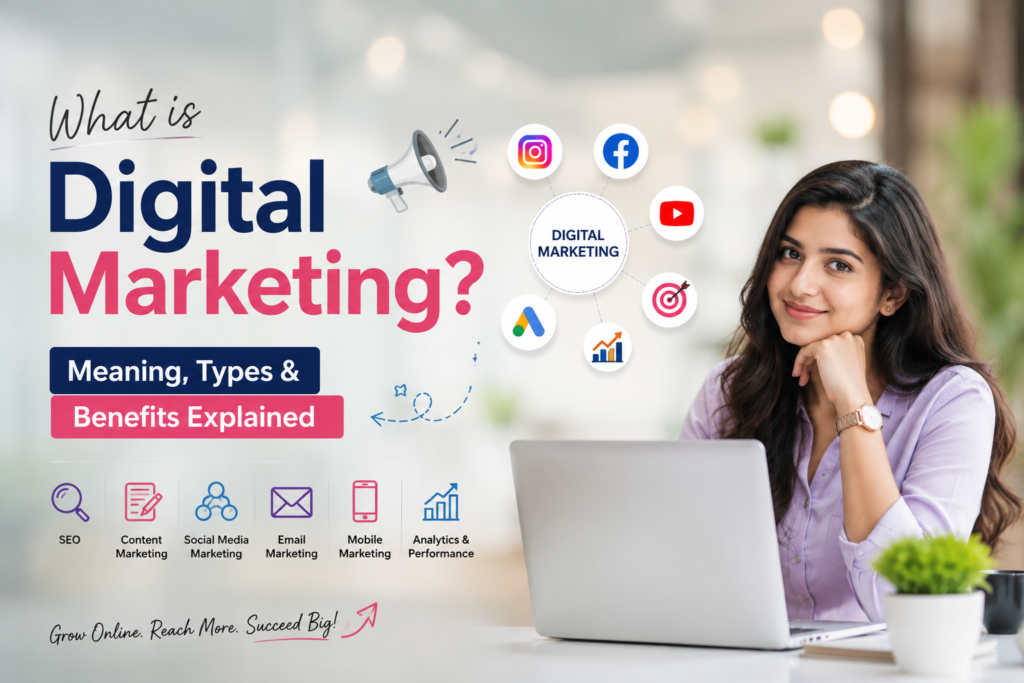
What is Digital Marketing? Meaning, Types & Benefits Explained

Meta Description: Discover what digital marketing is, its meaning, different types (SEO, social media, PPC, content marketing), and key benefits for businesses looking to grow online. Introduction In today’s connected world, almost every business — big or small — needs an online presence to survive and grow. This is where digital marketing comes in. But what exactly is digital marketing, and why has it become so important for businesses of all sizes? Let’s break it down in simple terms. What is Digital Marketing? Digital marketing refers to the promotion of products, services, or brands using digital channels such as search engines, websites, social media, email, and mobile apps. Unlike traditional marketing (newspapers, TV, billboards), digital marketing uses the internet and electronic devices to connect with potential customers where they spend most of their time — online. In simple words, digital marketing is any marketing effort that uses the internet or an electronic device. Why is Digital Marketing Important? Types of Digital Marketing 1. Search Engine Optimization (SEO) The process of optimizing your website to rank higher on search engines like Google, helping you get free (organic) traffic. 2. Social Media Marketing (SMM) Promoting your brand on platforms like Instagram, Facebook, LinkedIn, and Twitter to build awareness and engage with your audience. 3. Pay-Per-Click Advertising (PPC) Paid ads on platforms like Google Ads or social media, where you pay only when someone clicks on your ad. 4. Content Marketing Creating valuable content — blogs, videos, infographics — to attract and retain a clearly defined audience. 5. Email Marketing Sending targeted emails to nurture leads, promote offers, and build customer relationships. 6. Affiliate Marketing Partnering with individuals or other businesses who promote your products for a commission on sales. 7. Influencer Marketing Collaborating with social media influencers to promote your brand to their followers. Benefits of Digital Marketing for Businesses Conclusion Digital marketing is no longer optional — it’s essential for any business that wants to grow in today’s digital-first world. Whether you’re a startup or an established brand, understanding and using digital marketing strategies can help you reach the right audience, build lasting relationships, and grow your business online. If you’re looking to grow your business through effective digital marketing strategies, feel free to reach out for a free consultation!

Scroll to Top